


Did you know that rhinoplasty as we know it isn’t the exclusive domain of our plastic surgeon colleagues?
Medical rhinoplasty is becoming increasingly important in aesthetic medicine. Thanks to hyaluronic acid injections, certain nasal corrections can be performed without surgery, provided that the procedure is indicated appropriately and the practitioner has a thorough understanding of the vascular anatomy of this area.
This article reviews the indications, techniques, and essential precautions you need to know before undergoing this treatment.
What is medical rhinoplasty?
Current filler injection techniques make it possible to perform non-surgical rhinoplasty with visible corrections that are sometimes very similar in appearance to the results of surgical rhinoplasty.
As with any treatment, the appropriate indication must be established. This depends on your expertise as a cosmetic physician, your analysis of the face, and your ability to identify what can be corrected medically and what requires surgical intervention.
For which conditions should it be considered?
Medical rhinoplasty may be considered in the following cases:
- In profile: tip lift / hiding a bump.
- From the front: slight deviation from the axis of the nasal bridge / narrowing of the nasal bridge.
The indications mentioned above may also apply in the context of surgical treatment. So why consider medical treatment?
Why choose medical treatment over surgery?
- Minimally invasive.
- Immediate results.
- No downtime.
- Fully reversible if necessary.
- Lower cost.
Medical rhinoplasty, therefore, is not a substitute for surgery in all situations. Rather, it is a viable option when the patient’s needs can be addressed through injection-based correction, using a gradual, reversible, and minimally invasive approach.
Preparing for the Procedure
As with any injection, the procedure is preceded by the patient’s signing of an informed consent form, disinfection of the treatment area, and the taking of photos from 3 to 5 different angles.
Injection Technique and Product Selection
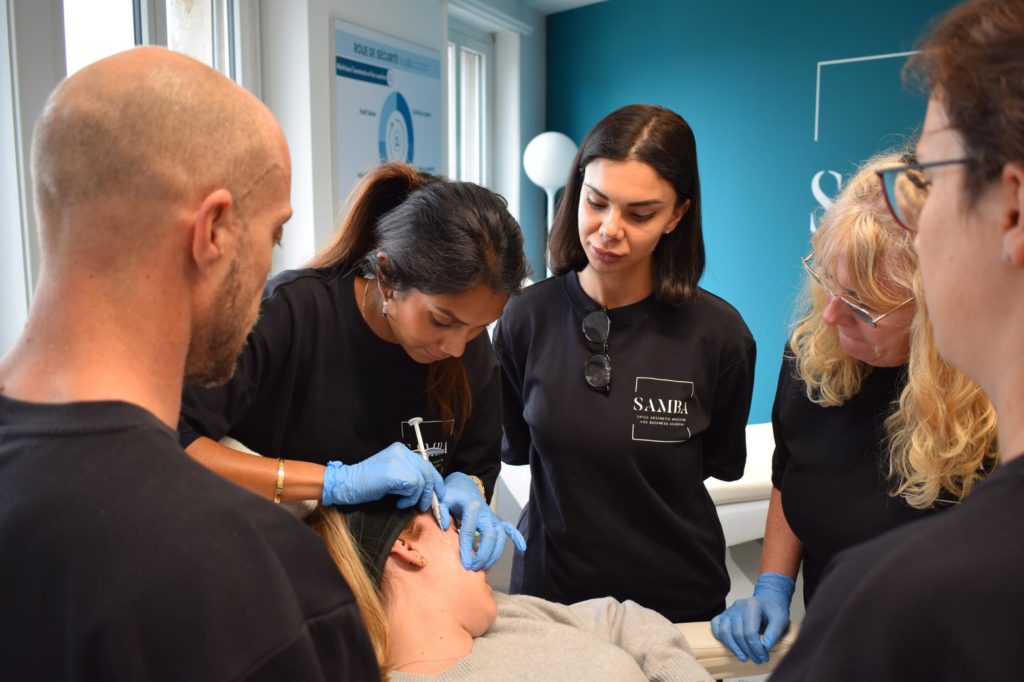
Techniques may vary by school: cannula or needle. Some experts prefer very fine-gauge needles for their precision, particularly when depositing very small amounts of product.
Regardless of the technique chosen, medical rhinoplasty remains a procedure with a high vascular risk, requiring a thorough understanding of anatomy and meticulous technique.
A high-G’ hyaluronic acid, such as Allergan’s Voluma, Merz’s Intense, or Vivacy’s XL, used with a 32G needle or smaller, allows for the injection of microboluses with great precision.
Profile Correction
Profile correction will be performed upstream from the bridge of the nose, below the lower edge of the eyebrows, and will focus on the tip of the nose to lift it.
Facial Correction
The facial correction will be performed along a subtle line that follows and corrects any deviation of the nasal ridge in order to accentuate the way light catches on the face.
Botulinum Toxin and the Tip of the Nose
A botulinum toxin injection into the nasal septum depressor muscle may be considered if the tip is mobile during movement.
Precautions and Safety
The nasal region is an anatomically high-risk area due to its rich blood supply and anastomoses. Preventing complications depends on selecting the appropriate indication, understanding the injection planes, using small volumes, injecting slowly, and closely monitoring the patient.
The risk of embolism—particularly monocular blindness in the event of migration into the terminal retinal artery—requires extreme caution. The goal, therefore, is to combine surgical precision, anatomical knowledge, and the appropriate choice of material.
Follow-up Care
There are no specific post-procedure recommendations, other than avoiding significant physical strain on the injected area for 48 to 72 hours: heavy-framed glasses, swimming goggles, or pressure applied to the nose.
According to the literature review, results generally last for about 18 to 24 months before a relapse.
A technique reserved for experienced injectors
When performed properly, medical rhinoplasty offers spectacular results. It should be noted that this is a treatment area best suited for experienced practitioners.
A thorough understanding of the fundamentals—such as those taught at SAMBA—is an essential prerequisite before training in medical rhinoplasty.