


Choosing a hyaluronic acid product may seem complicated when you’re just starting out in aesthetic medicine. However, with a few simple basics—rheology, the G’ value, and the five-layer anatomy—the reasoning becomes much clearer.
The goal isn’t to memorize all the references, but to understand what type of product to use, in which shot, and to achieve what effect.
I am learning the theoretical basics of hyaluronic acid used for cosmetic purposes
Definition
I often say that hyaluronic acid (HA) is basically water in gel form—but a bit pricey.
It is, in fact, a gel made of polysaccharides.
Unlike native hyaluronic acid found in the extracellular matrix, the hyaluronic acid used in injectables is cross-linked.
It is reinforced, much like reinforced concrete, and therefore resists degradation by hyaluronidase for much longer.
The more cross-linked it is, the “stronger” it is.
Rheology
Rheology describes hyaluronic acid in terms of its cross-linking properties.
We’re talking about elasticity, plasticity, viscosity, and cohesiveness.
One indicator is particularly useful for understanding the firmness and spreading ability of hyaluronic acid: G’.
I really enjoy simplifying concepts when I’m training my colleagues.
The G’ is simple and universal:
The higher the G, the stiffer your AH. The lower it is, the more flexible your AH.
If you keep this in mind, you’ll make few mistakes when choosing a product from your AH line.
Next, I learn the basics of anatomy
The 5-Layer Concept
Learning facial anatomy layer by layer makes it simpler, more fun, and something you can repeat over and over again.
The face is composed of five distinct layers (see the article “The Five Layers of the Face: An Essential Concept in Aesthetic Medicine”).
The skin, superficial fat (hypodermis), SMAS, deep fat, and bone covered by the periosteum.
Over time, all of these layers undergo atrophy or resorption. They can therefore be treated with cross-linked hyaluronic acid fillers to counteract this process.
A Simple Guide to Choosing the Right Hyaluronic Acid
Once you’ve mastered these simple concepts, all you need to do is apply the following formula:
The deeper it is, the higher the G’ I use. The shallower it is, the lower the G’ I use.
To perform a facelift, I will administer periosteal injections in the midface using a hyaluronic acid with a high G’ value.
I want it to maintain its shape and prevent bone resorption so that the fat compartments can be repositioned and anchored higher up.
To fill in a nasolabial fold or marionette lines, I’ll use a hyaluronic acid with a medium molecular weight.
I inject into the subcutaneous layer to counteract the atrophy of superficial fat. I want it to spread out, but still retain some shape to restore the hypodermic support that has been lost with aging.
I can do this with a needle or a cannula, using, for example, the fanning technique.
To fill in a frown line, crow’s feet, or a forehead wrinkle, I’ll use a hyaluronic acid (HA) with a low G value.
I’m looking for a product with good spreadability. So I use the needle blanching technique to inject it into the superficial dermis.
These concepts provide an essential foundation for choosing a hyaluronic acid in a more logical, safer, and more reproducible manner.
I’ve been injecting daily for over 10 years, and I use nothing but these few simple concepts.
Which lab should I choose?
There is a wide range of hyaluronic acid products available, with quite a few excellent manufacturers offering very high-quality products.
Among them are Vivacy, Merz, Allergan, Teoxane, Galderma, and many others.
They all offer a range of hyaluronic acids with low to high G’ values, allowing for injection into the periosteal, subcutaneous, and intradermal layers.
The examples below provide a general framework for interpreting the ranges, but the final decision must always take into account the laboratory’s recommendations, the indication, the injection plan, and the practitioner’s experience.
Depending on the cross-linking and the G’, the products have different names.
At Vivacy
From the lowest to the highest G’, we find:
S, M, L, XL, XXL—just like clothes… it’s that simple.
At Merz
From the lowest to the highest G’, we find:
Soft, Balance (Lip Contour), Volume, Intense (Lip Shape).
At Allergan
From the lowest to the highest G’, we find:
Juvederm Line: Juvederm 2, 3 (Ultra Smile), 4… it’s that simple.
Vycross Line: Volbella, Volift, Voluma, Volux.
At Teoxane
From the lowest to the highest G’, we find:
Teosyal Line: Redensity 1, Redensity 2, First Lines, Global Action, Deep Lines, Ultra Deep.
Teosyal RHA Line: RHA 1, RHA 2, RHA 3, RHA 4, RHA Kiss.
At Galderma
From the lowest to the highest G’, we find:
OBT Line: Refyne, Defyne, Kysse, Volyme, Contour.
NASHA Line: Restylane, Eyelight, Lyft.
In a nutshell
If you want to get started in aesthetic medicine, sign up for a training program:
- which provides you with a comprehensive and solid theoretical foundation;
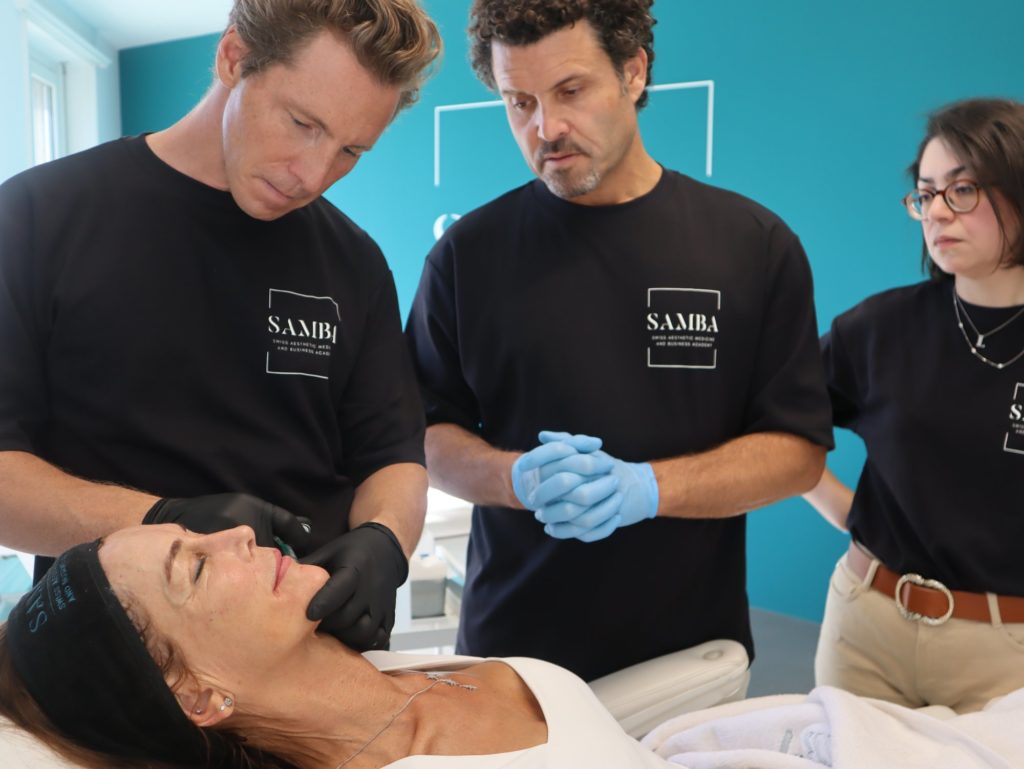
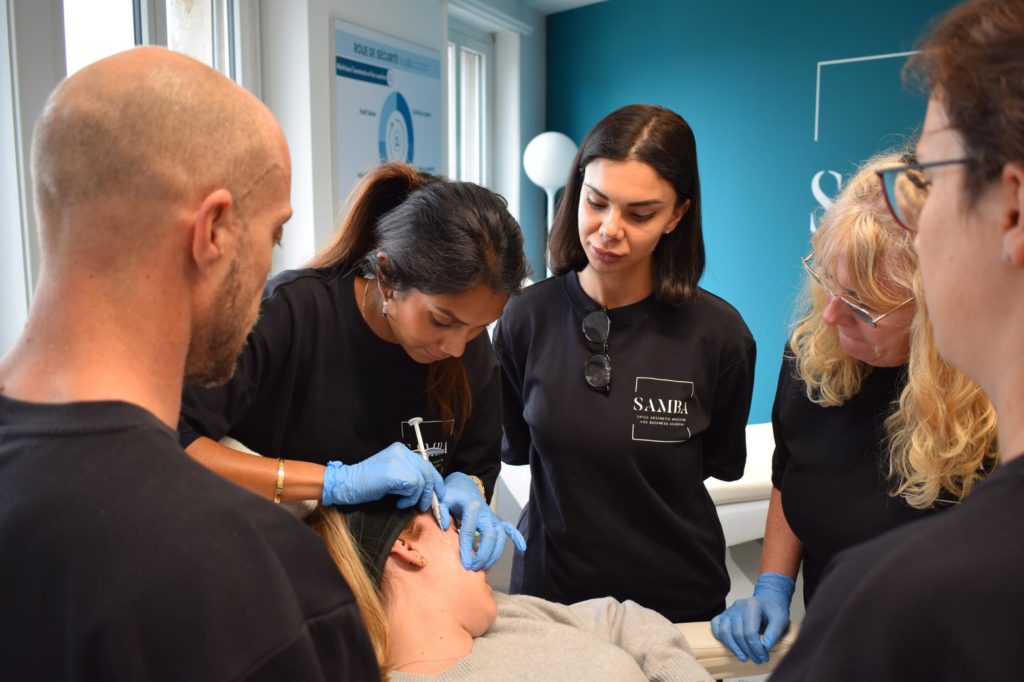
- with hands-on sessions to master essential techniques: periosteal, subcutaneous, and blanching;
- with a network that connects you with representatives from local laboratories so you can order your first boxes.
Getting started in aesthetic medicine is as easy as SAMBA.