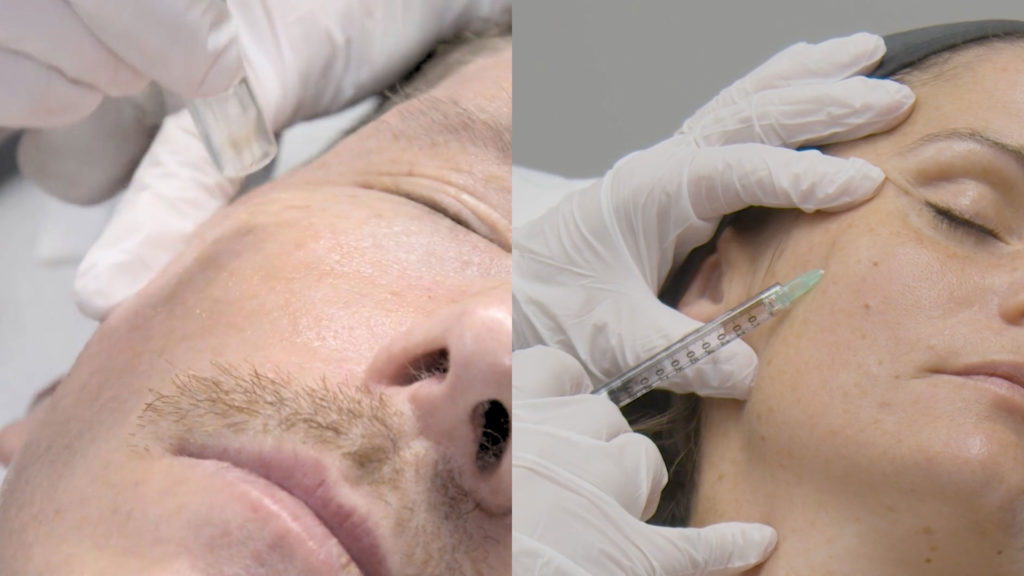


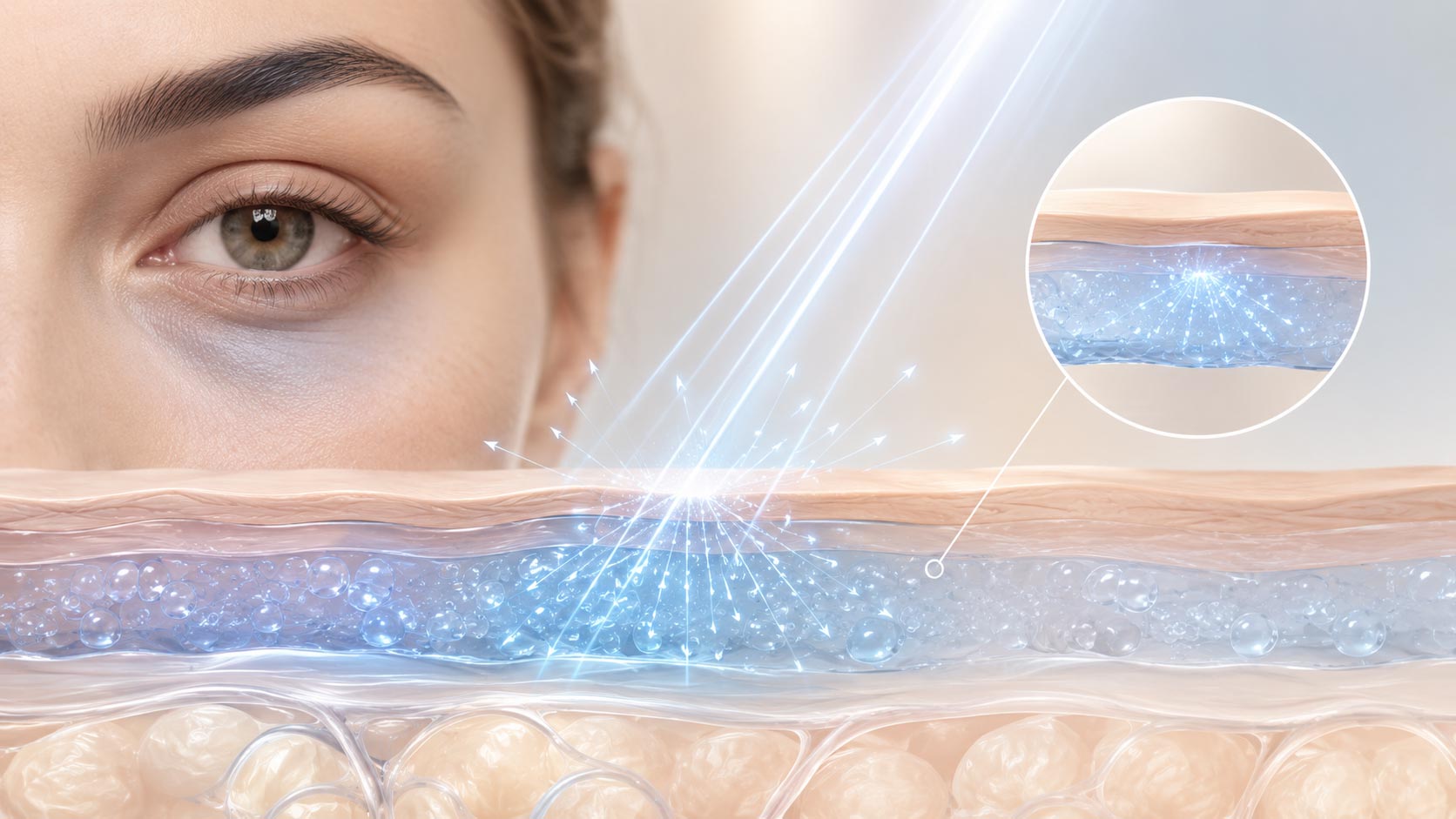
The Tyndall effect is the phenomenon of light scattering in a fluid or gel, also called a colloid. As a result, the light beam becomes visible and the fluid may appear to have a bluish or greyish tint.
Why does it matter in aesthetic medicine?
This phenomenon can also be observed in aesthetic medicine. Hyaluronic acid can reflect short-wavelength light, such as blue light, while absorbing longer wavelengths, such as red light.
Clinically, this may appear as a bluish-grey discoloration under the skin, often confused by patients with a bruise. Understanding the Tyndall effect is therefore important, especially when treating delicate areas such as the tear trough or other zones with thin skin.
Why does it happen?
The Tyndall effect can occur for several reasons:
A poorly placed dermal filler
The product may have been placed too superficially in the dermis. In this case, the filler can scatter light and create a bluish or greyish appearance under the skin.
Thin skin
Thin skin, especially under the eyes, makes this phenomenon more visible. In this area, light can be scattered by the hyaluronic acid gel and mimic or accentuate the appearance of dark circles.
Poor choice of filler
Using a filler that does not integrate well into the tissue, or a product designed for deeper layers, can increase the risk of a visible Tyndall effect when placed too superficially.
Product accumulation
A large bolus of hyaluronic acid is more likely to cause a Tyndall effect than a product distributed evenly through small aliquots. Careful placement and controlled quantities are therefore essential.
What can you do about it?
There are two main ways to manage a Tyndall effect:
Massage the product early
If the issue is identified immediately, massaging the product can help avoid clumping and improve integration into the tissue.
Use hyaluronidase
Hyaluronidase is the most effective treatment when correction is needed. It dissolves the hyaluronic acid gel and can remove the Tyndall effect rapidly.
Why is there usually no Tyndall effect with the blanching technique?
Blanching is a technique used to treat superficial wrinkles, such as smoker’s lines. The filler is injected into the superficial dermis and puts pressure on the capillaries, temporarily pushing blood out of them and turning the skin white.
The reason this technique usually does not cause a Tyndall effect is mainly related to the type of product used. Products such as Belotero Soft are made with a Cohesive Polydensified Matrix, or CPM. This means that the gel is very fluid and spreads easily between collagen fibers, reducing the risk of clumping.
Key takeaway
The Tyndall effect is usually linked to a combination of superficial placement, thin skin, filler choice and product accumulation. Preventing it requires a precise understanding of the injection plane, the treated area and the rheology of the chosen filler. When it occurs, early recognition and appropriate correction allow the physician to manage it effectively.