

During the early stage of an aesthetic doctor career, botulinum toxin injection can be tricky. Especially since the injector cannot see the result right away and must wait for almost 2 weeks to appreciate his work. It is common at the beginning of your career to have a patient return to our office with a strange look almost as if she or he is suspicious of something.
This look is called the Mephisto effect and can be explained and avoided.
What is the Mephisto effect?
It is a temporary side effect in aesthetic medicine that can happen and settle 1-2 weeks after a botulinum toxin injection. This effect is characterized by an unnatural and strange look of the patient’s eyebrow where the outer tails of the eyebrows tend to have an excessive uplifting. This gives the patient a sinister or suspicious look, especially when she or he tries to lift the eyebrows up.
Why do we call it Mephisto?
The name comes from Mephistopheles, a demon featured in German folklore. He was the chief devil in the Faust legend (15th to 17th Century). Since then, he has appeared in many works of art as this evil character with his mischievous look. His eyebrows always portrayed with an uplifted tail are the reason why the term was given to this side effect in aesthetics.
Let’s talk about the anatomy of the upper 1/3 of the face
We divide 3 botulinum toxin injectable zones in the upper 1/3 of the face: the glabella, the crow’s feet and the forehead.
The glabella (or lion’s wrinkle) and the crow’s feet are called depressive zones. Respectively, they are formed of the corrugators, the procerus, and the lateral portion of the orbicularis oculi muscles. Depressive means that they pull the upper 1/3 of the face down. So, blocking them with botulinum toxin will lift these 2 areas up.
The frontalis muscle of the forehead however is the only lifting muscle of the 1/3 of the face. So, blocking it will have a depressive effect.
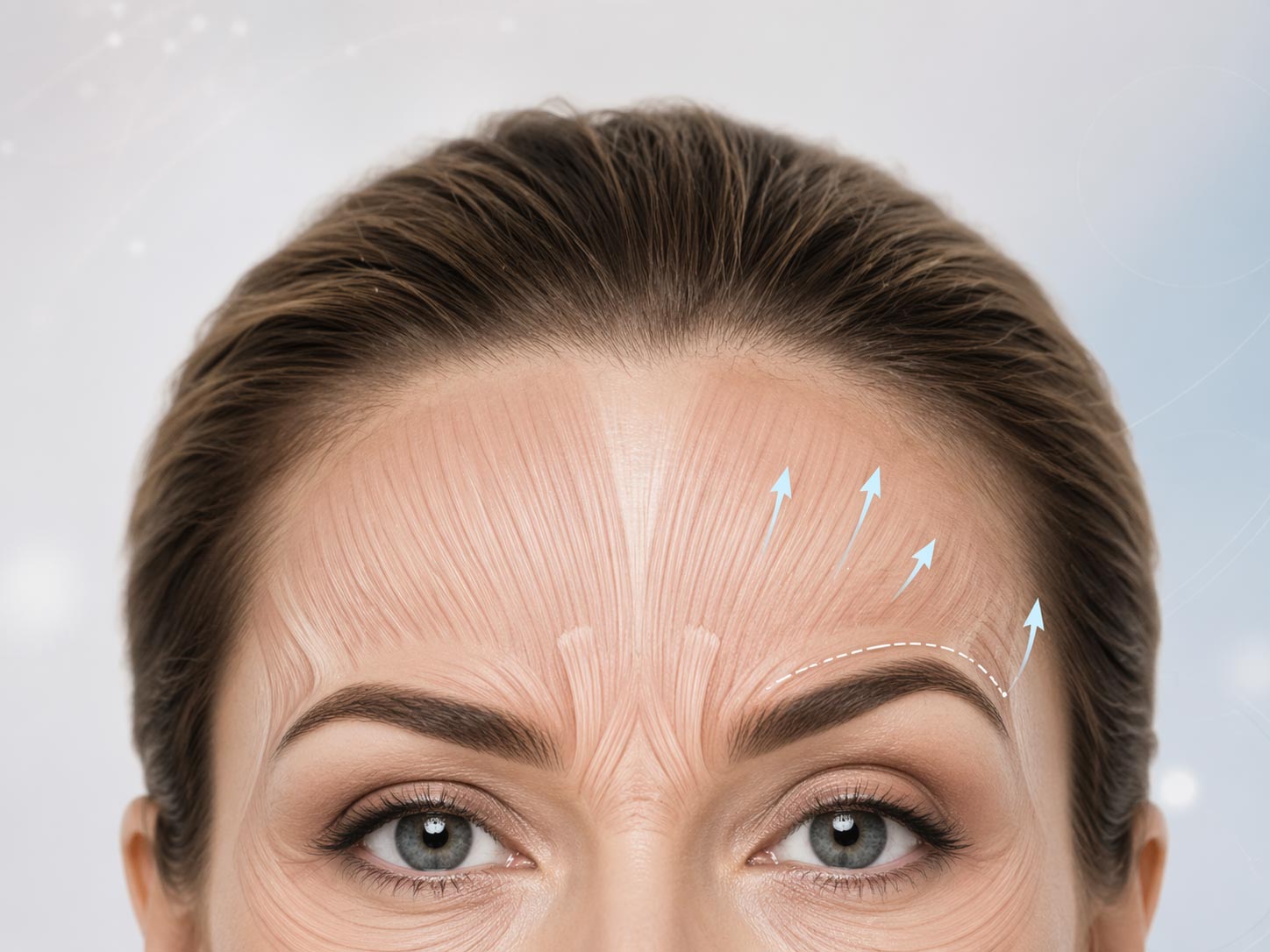
The frontalis is a large muscle that almost runs from the hairline (galea aponeurotica) down to the brow ridge and has an important function of lifting the eyebrows up. Its fibers are often divided between medial and lateral.
What is the medical explanation for the Mephisto effect
The main cause of the Mephisto effect is the treatment of the frontalis muscle. When the medial fibers are treated with botulinum toxin but the lateral ones are not blocked, it allows the lateral portion of the eyebrows to be lifted upwards while the medial portion remains horizontal and thus creating this sinister/suspicious Mephisto effect.
Another documented reason in the literature can be due to a hyperactivation of the lateral fibers of the frontalis when the depressive muscles are effectively blocked. However, in most cases during our early practice as aesthetic doctors, it is due to the frontalis muscle not properly blocked in its lateral portion.
How to handle this situation
First, reassure your patient! In aesthetics, nothing is going to last forever. Moreover, almost everything can be corrected with the right knowledge and training.
A Mephisto effect without any correction will only last around 3 months depending on the patient, the toxin’s dose, and efficacy.
But you should not leave your patient looking suspicious for 3 months as there is a way to correct it. You can do that by placing 1 or 2 international toxin unit on the lateral aspect of the frontalis muscle, exactly about 1.5 to 2cm above the highest point of the eyebrow’s arch.
However, be careful not to overcorrect! By injecting too many units of toxin or placing them too low on the frontalis muscle, you might create heaviness on the eyebrow and thus a slight eyelid drooping which will be more annoying to your patient than the Mephisto itself.
My advice to you
Practice! As much as you can! And do not forget that mistakes are part of your training and they will make you a better injector in time. An injector who never had a Mephisto effect does not exist!
At the early stages of your career, focus more on mastering a proper glabella and crow’s feet toxin injection as it will always have a lifting effect on the eyebrows and eyelids. This will ensure a happy patient with eyes looking less tired.
Once you have mastered those 2 zones, then start treating foreheads. It is the trickiest zone to treat as it can cause heaviness and drooping of the eyelids as well as the Mephisto effect.