

In aesthetic medicine, understanding the different anatomical layers of the face is essential for choosing the right treatment, injection plan and management strategy. The “5 layers” concept helps to simplify this anatomical reading, making practice safer, more reproducible and more educational, both for doctors and their patients.
In aesthetic medicine, there is a specific knowledge that only targeted training can provide. Today, I’d like to talk to you about a very important concept, one that is still too little known, even by some so-called “experienced” practitioners: the concept of the 5 layers that make up the human face.
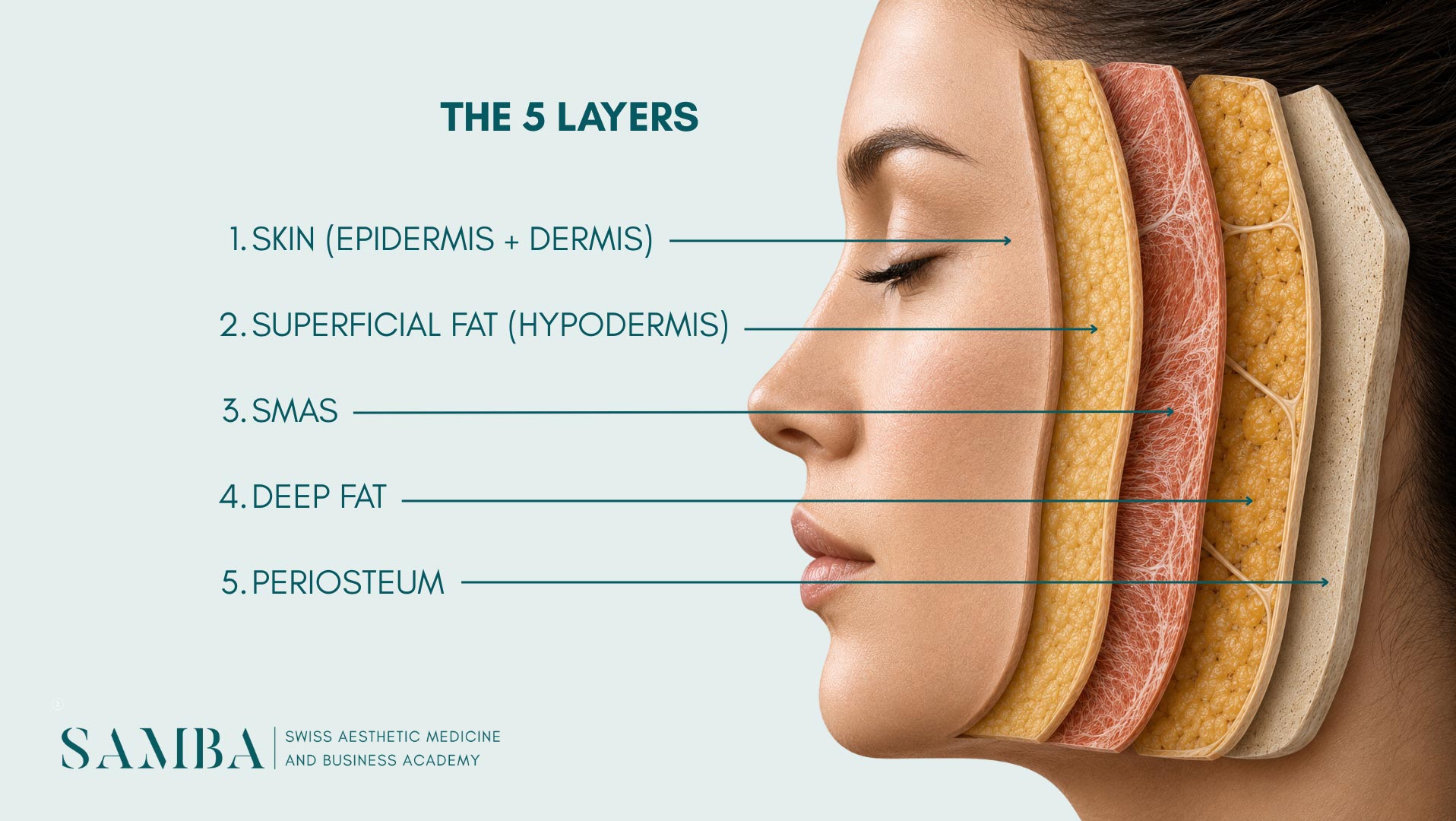
SKIN – SUPERFICIAL FAT – SMAS – DEEP FAT – PERIOSTEUM
Like all concepts, it must be kept simple, so that it can be taught quickly and easily to all, especially patients. In cadaveric anatomical dissection, this organization is found in all areas of the face. Depending on the region, there are of course more or fewer intermediate layers, and the anatomical reality is more complex. But in day-to-day use, this 5-layer approach is reproducible, efficient and safe.
The first layer: the skin (epidermis and dermis)
In aesthetic medicine, the epidermis and dermis are mainly considered to belong to this first layer. In dermatology, it also includes the hypodermis. In aesthetic medicine, the hypodermis is a specific treatment delivery zone, and is therefore individualized as the second layer.
The epidermis
Composition
The epidermis is essentially composed of keratinocytes, but also of Langerhans cells, Merkel cells (involved in immunity) and melanocytes (responsible for pigmentation).
Function
- Essential role as a barrier against environmental aggression.
- Regulates the hydrolipidic film.
- Regulation of skin pigmentation.
Thickness
From 0.05 to 0.2 mm depending on the area of the face.
The dermis
Composition
The dermis contains fibroblasts, which produce the elastin, collagen and hyaluronic acid that make up the extracellular matrix (ECM). It also includes a vascular and sensory network.
Function
The dermis provides the skin’s support and elasticity. It also plays a role in deep hydration, thermoregulation and sensory perception.
Thickness
From 1 to 4 mm depending on the area of the face.
Skin treatments in aesthetic medicine
Peelings, microneedling, skinboosters, lasers (resurfacing, vascular, pigmentary, hair removal), mesotherapy, PRP (platelet-rich plasma) and hyaluronic acid bleaching.
The second layer: superficial fat
Also known as the hypodermis, it corresponds to the subcutaneous plane, often described for injection treatments in particular.
Composition
It’s made up of adipocytes, but also connective tissue organized into septa, which help maintain the structure. Vessels also circulate in these septa, as does the lymphatic drainage system.
Function
- Storage of triglycerides and fatty acids.
- Volume and facial contour.
- Skin support.
Thickness
Like all fatty tissue, its thickness varies considerably according to location and individual.
The third layer: the SMAS (superficial musculoaponeurotic system)
Composition
The SMAS is composed of facial muscles, fascia and ligaments. Although it cannot be identified as a horizontal layer in the same way as the others, since the skin muscles are oriented from the periosteum to the skin, it always lies between superficial and deep fat. As such, in aesthetic medicine, it constitutes an important reference point between subcutaneous and deep injections, notably periosteal.
For the sake of clarification and simplification, and for the learning and education of doctors and patients alike, the SMAS is described as a sheet located between the two layers of fat, superficial and deep.
Function
The SMAS maintains the soft tissues of the face. It helps keep fatty compartments in place, and also contributes to facial expression and mimicry via the skin muscles, which are the only muscles in the human body to have both bone and skin insertion.
The fourth layer: deep fat
Composition
Like subcutaneous fat, deep fat is made up of adipocytes. Deep fat is more stable than superficial fat. It is organized more in projections, unlike superficial fat, which spreads out like a support tissue for the skin.
Between the fat lobules are septa of connective tissue that help maintain the position of the fat compartments.
Function
Deep fat supports superficial tissues, projecting volume and cushioning between muscles and bone structure. Combined with the bone layer, it helps define facial contours and morphological identity.
The fifth layer: the periosteum
Composition
The periosteum is the covering layer of the facial bone mass.
Function
- Structural support for facial volumes.
- Three-dimensional positioning and projection of fabrics.
- Protection of the central nervous system and sensory organs.
Combined with the deep fat compartment, it plays a decisive role in the morphological identity and relief of the face.
Why is it important to master the concept of the 5 layers as an aesthetic doctor?
To speak the same language
By sharing the same knowledge and approach, aesthetic physicians can speak the same language and progress on a common basis.
To define a specialty
In all specialties, there are simple concepts and fundamentals on which practitioners agree. It is through this consensus that a specialty is designed, and then that new concepts are developed from this base.
To free up skills
Speaking in a simple language that can be easily transposed into practice frees up energy and talent. It’s the starting point for developing the specialty.
By simplifying, we increase overall competence, the critical mass of practitioners capable of working properly, and therefore the potential for innovation and progress in the discipline.
To educate patients and the general public
A general public with a better understanding
Understanding anatomy in a simple way also means understanding aging. It means clearly explaining the evolution and physiology of facial and body aging. Conveying a clear message to patients increases their confidence, satisfaction and adherence to synergistic care programs.
Distinguishing yourself through rigorous medical practice
Mastering simple concepts and passing them on to your patients sets you apart from non-medical or illegal practices in aesthetic medicine. It helps patients understand that harmonious, safe and long-lasting aesthetic medicine requires mastery of all dimensions of the practice.
To achieve such results, you also need to have access to a complete and appropriate technical platform. This requirement makes medical training, anatomical analysis and the ability to offer truly personalized care all the more important.
Patient loyalty
Mastering simple concepts and passing them on to patients helps them understand that aesthetic medicine :
- is a long-term treatment;
- is a multidisciplinary approach;
- is a multi-dimensional approach.
It’s a whole, orchestrated by a competent doctor, capable of safely and effectively implementing a comprehensive, long-term care program for the benefit of his or her patient.
Conclusion
Training in the fundamental concepts of modern aesthetic medicine means improving patient satisfaction, reinforcing adherence to treatments, making procedures safer and enabling doctors to develop their skills to the full.