

The treatment of facial sagging is not limited to dermal fillers, biostimulation, or surgery.
Absorbable tension threads now play a full-fledged role in the cosmetic physician’s arsenal. In appropriately selected patients, they allow for the repositioning of certain tissues within a specific subcutaneous plane—tailored to the treatment area and the device—in order to improve facial contours through a minimally invasive procedure.
As with any cosmetic procedure, the first step is determining whether it is appropriate.
Who Are Tightening Threads For?
They are primarily useful for mild to moderate relaxation, including:
Sagging of the middle third of the face
- Moderate sagging of the cheek.
- A pronounced nasolabial fold, when accompanied by sagging of the midface.
Sagging of the lower third of the face
- Beginner’s Cheeks.
- Pronounced lines of bitterness, when they are part of sagging in the lower third of the face.
- Loss of facial contour definition.
The goal, therefore, is not to fill in the area, but to reposition the tissues and improve the jawline.
In what cases are thread lifts less suitable?
Thread lifts are not the best option in cases of significant sagging, marked excess skin, a heavy-looking face, or when the patient expects results comparable to those of a surgical facelift. Any contraindications related to the device, the patient’s skin condition, or overall health must also be assessed prior to treatment.
Why Offer Tension Threads?
Filler injections primarily restore volume and support. Surgery provides greater skin tightening when sagging is pronounced. Thread lifts fall between these two approaches for patients with mild to moderate ptosis who prefer a minimally invasive procedure.
This technique has several advantages:
- This procedure can be performed at the office.
- The lifting effect is generally visible immediately and then gradually becomes more pronounced as the tissues settle.
- No surgical scar.
- Social exclusion is generally limited.
- Natural expressions are preserved when the indication and vectors are appropriate.
- Can be combined with other aesthetic medicine techniques.
Not all wires are the same
The absorbable sutures currently in use may be made of PDO (polydioxanone), PLLA (poly-L-lactic acid), or PCL (polycaprolactone), among other materials.
But beyond the material itself, the architecture of the wire also contributes to its tensile strength: notched wires, bidirectional wires, multidirectional wires, or systems that use different anchoring mechanisms.
The notches allow the thread to anchor itself in the subcutaneous tissues, creating mechanical traction and redistributing certain volumes.
In addition to this immediate effect, tissue reaction occurs around the suture as it is absorbed. Collagen stimulation and tissue remodeling have been described, although their exact contribution to the long-term clinical outcome remains a matter of debate.
The implantation technique is crucial
After analyzing the face in both static and dynamic states, the traction vectors are drawn based on the patient’s ptosis and anatomy.
The goal isn’t to take as many shots as possible, but to choose the right angle, the right shot, and the right composition.
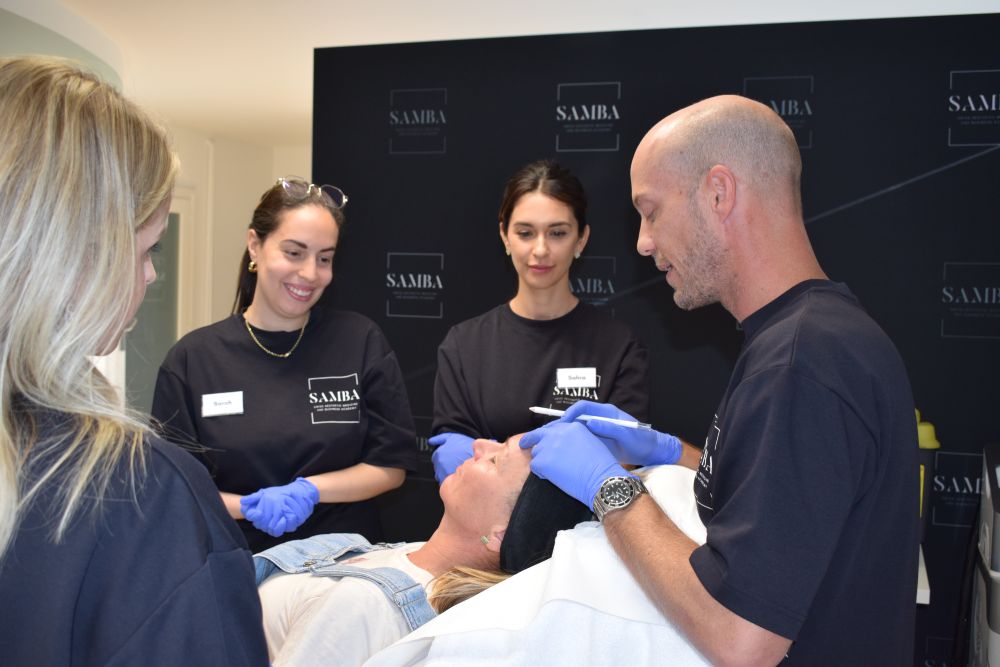
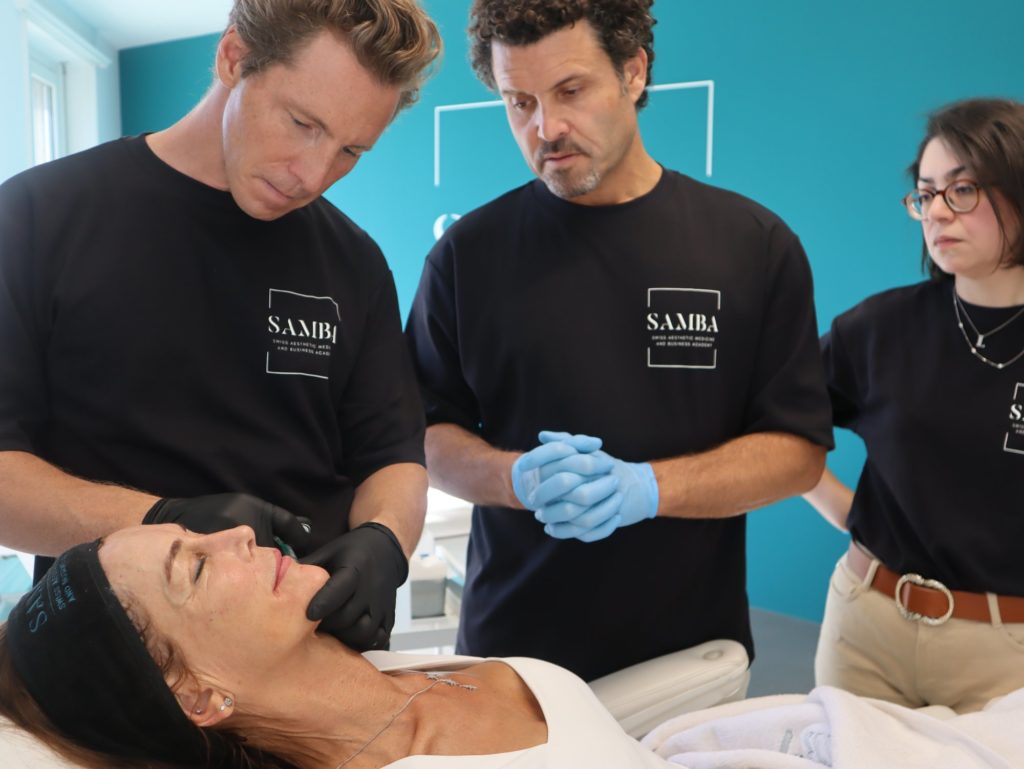
The threads are generally inserted using a needle or a cannula, depending on the device used. Precision in the insertion technique is essential: a thread placed too close to the surface may become visible or cause skin irregularities; an improper placement may compromise the treatment’s effectiveness and increase the risk of complications.
A thorough understanding of facial anatomy, as taught at SAMBA, is therefore essential.
Possible consequences and complications
Swelling, bruising, local tenderness, a feeling of tightness, and minor, temporary skin irregularities are among the possible side effects. The literature also reports less common complications such as the thread being visible or palpable, extrusion, migration, infection, or paresthesia.
A slight asymmetry or swelling may occur in the first few days and is often temporary.
As with any cosmetic medical procedure, the patient must be provided with clear information about the expected benefits, limitations, and potential complications of the treatment.
In the days following the procedure, it is usually recommended to limit significant mechanical stress (exaggerated facial expressions, loud laughter, etc.) on the treated areas and to avoid unnecessary manipulation or massage.
How long do the results last?
This is probably the point where we need to be most cautious.
The lifting effect may be visible immediately, but it evolves over time as the tissues settle and the suture is gradually absorbed. The duration depends on the material used, the device, the technique, and the patient’s characteristics. Some manufacturers (APTOS, SINCLAIR, or CROMA) report that certain absorbable sutures can last up to 18 to 24 months, but the clinical effect should always be presented with caution and without promising a universal duration.
Key Takeaways
Thread lifts are not a substitute for a surgical facelift.
In the right patient, with the appropriate indication, suitable vectors, and a technique performed with perfect precision, they nevertheless represent a particularly valuable option between injections—which may be combined—and surgery.
The task may seem simple. Knowing where, why, and at what angle to lay a wire is where the real challenge lies.
As with advanced injection techniques, a thorough understanding of anatomy, facial aging analysis, and the fundamental techniques of aesthetic medicine is an essential prerequisite. This foundational knowledge must be acquired before undergoing specific training in thread lifts.