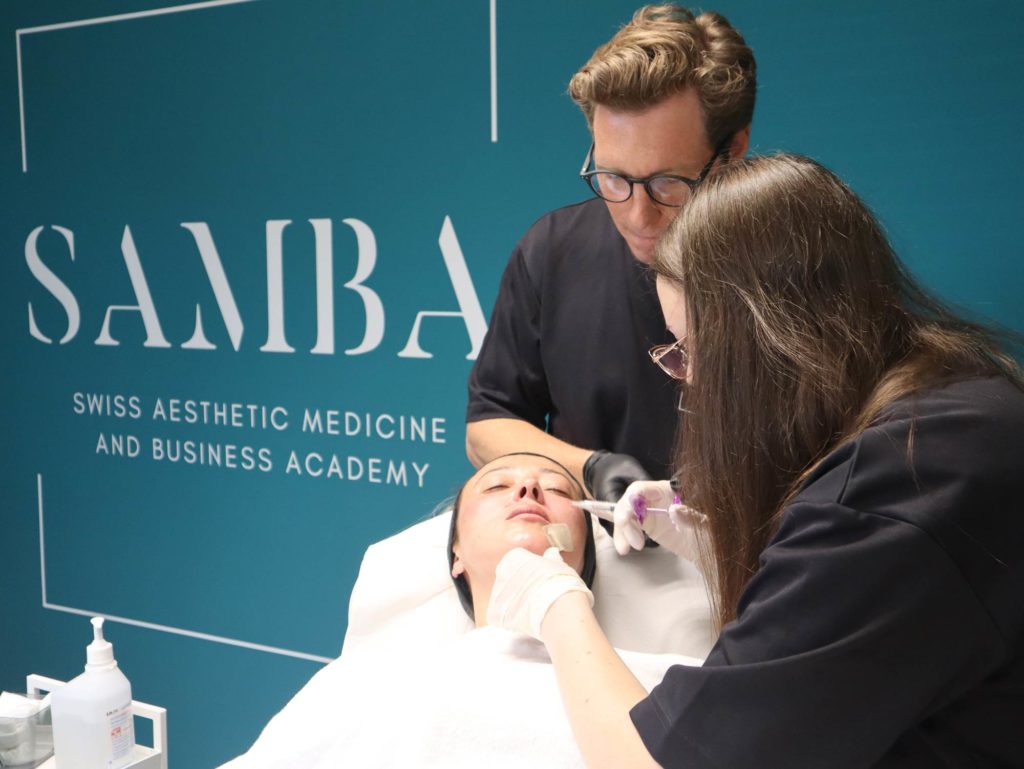


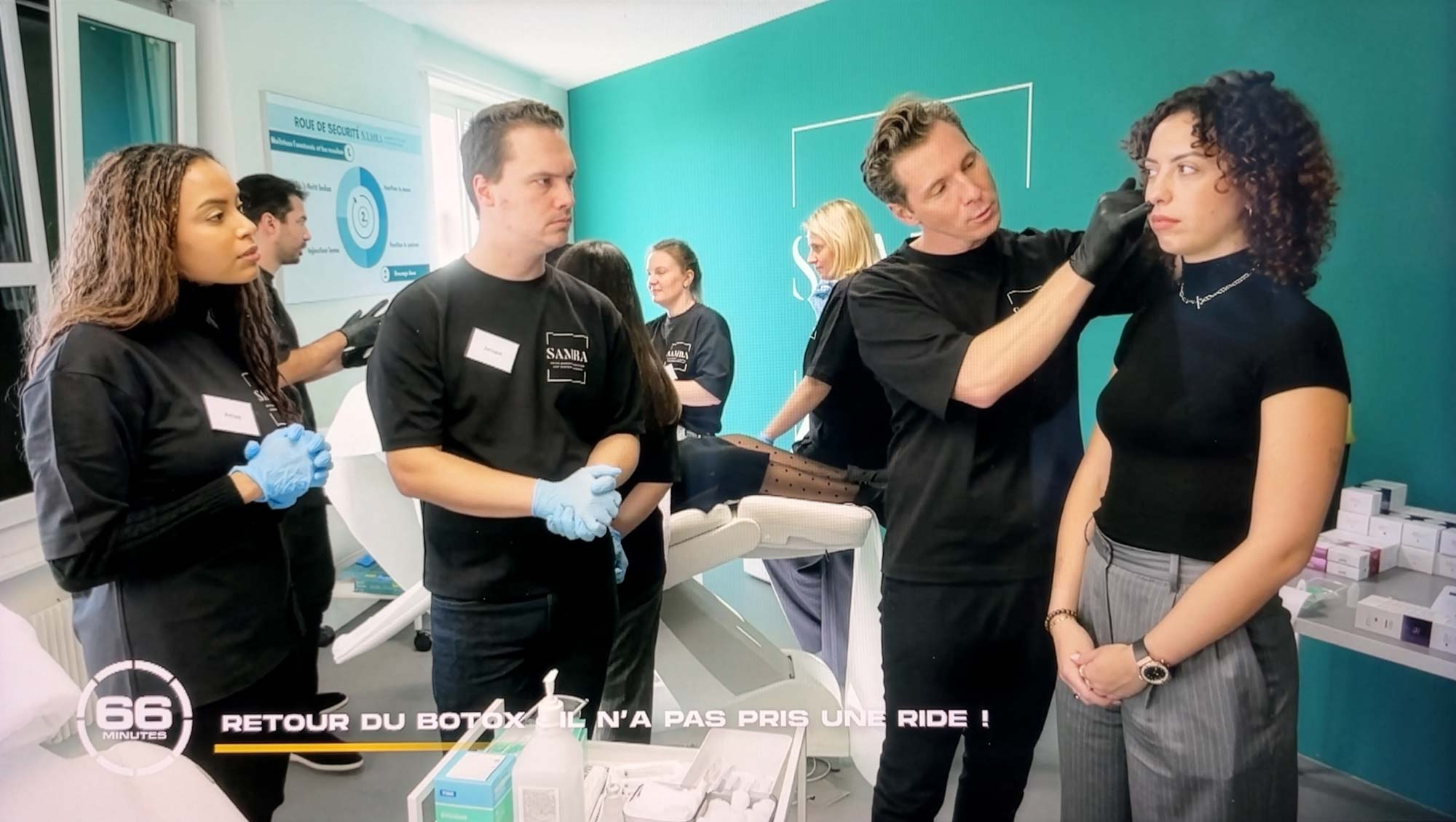
You may have seen it on TV recently. The cameras of M6 and the TV show “66 Minutes” set foot in Lausanne, at the heart of our SAMBA academy.
Beyond the pride of seeing our work recognized, this report highlighted a fundamental point of our profession: the reality of the field. No Instagram filters, no unrealistic promises, but real medicine, with real patients and real students in learning situations.
The report focused on a fascinating clinical case that I wanted to decipher with you today: the Gummy Smile.
It’s the perfect example of why “injecting” can’t be improvised.
Behind the scenes: “A practitioner is a practitioner”.
In the report, you see doctors from all over Europe, gathered around a breakfast before tackling the hard part. What the voice-over underlines – the famous 13,000 euro training fee – is the investment needed to ensure the safety of your future patients.
For it cannot be repeated often enough: theory is indispensable, but the hand must learn the gesture.
We welcomed Marion, a young patient aged 28, who had a complex about her gums showing too much when she smiles. She explains her feelings very well: “When I smile hard, I feel like you can really see all my gums”.
This is where our role as aesthetic doctors comes into its own. It’s not a question of transforming Marion, but of correcting a slight muscular imbalance to restore her confidence.
The “Gummy Smile”: a little anatomy
Why does Marion have that gummy smile? It’s not a tooth or gum problem per se. It’s muscular.
The culprit has a rather barbaric name: the levator lipis superioris alaeque nasi muscle. In some patients, this muscle is a little too enthusiastic. It is hypertonic. As soon as it receives the command to smile, it pulls the upper lip too high, exposing the gum.
The aim of the treatment is not to paralyze the face (I refer you to my article on frozen faces!), but to calm the muscle.
As I often say, botulinum toxin is like salt in a recipe. You need the right dose, in the right place.
Technique: a matter of millimetres
In the video, you can see me guiding my colleagues to the precise injection point.
We look for a very specific area: almost in the angle of the nasolabial fold.
Why here? Because this is where we can intercept the levator muscle to reduce its force of contraction without impacting the other muscles of the smile (like the zygomaticals).
If you stitch too low, you risk affecting the width of the smile. Too high and there’s no effect. It’s a question of absolute anatomical precision.
That’s exactly why we do “Hands-on” at SAMBA. In the report, I ask: “Who wants to do the right side? Who wants to do the left side? The doctor needs to feel the resistance of the tissue, locate the injection point and place the product with confidence.
The result: The proof is in the pudding
The report gives us the luxury of seeing the result at 15 days (the classic time for botulinum toxin to take full effect).
The change is subtle but radical for the patient:
– Before : The gums are highly exposed to forced smiling.
– After: The lip lifts, the smile is natural, the teeth are visible, but the gums remain discreetly covered.
Marion smiles broadly, and that’s what it’s all about. No face freeze, just harmonization.
Conclusion
This appearance on “66 Minutes” isn’t just a showcase. It’s a demonstration that aesthetic medicine, when taught with rigor (the Swiss Touch!) and practiced by trained doctors, provides concrete, safe solutions.
Gingival smile treatment is typically the kind of procedure that looks “easy” from the outside (a single injection point on each side), but requires perfect mastery of the anatomy to avoid creating asymmetry.
That’s what our mission at SAMBA is all about: transforming medical doctors into aesthetic experts, capable of analyzing a face, making the right indications and using the right techniques.
If you’re a doctor and you too would like to master these subtleties, you know where to find us. And for patients: always insist on a trained practitioner.